
 HomeWorkProfileField NotesContact
Reach out
Thanks, I’ll be in touch.
That didn't go through. Try again, or email hello@ryanburlinson.com.
HomeWorkProfileField NotesContactThanks, I’ll be in touch.


light
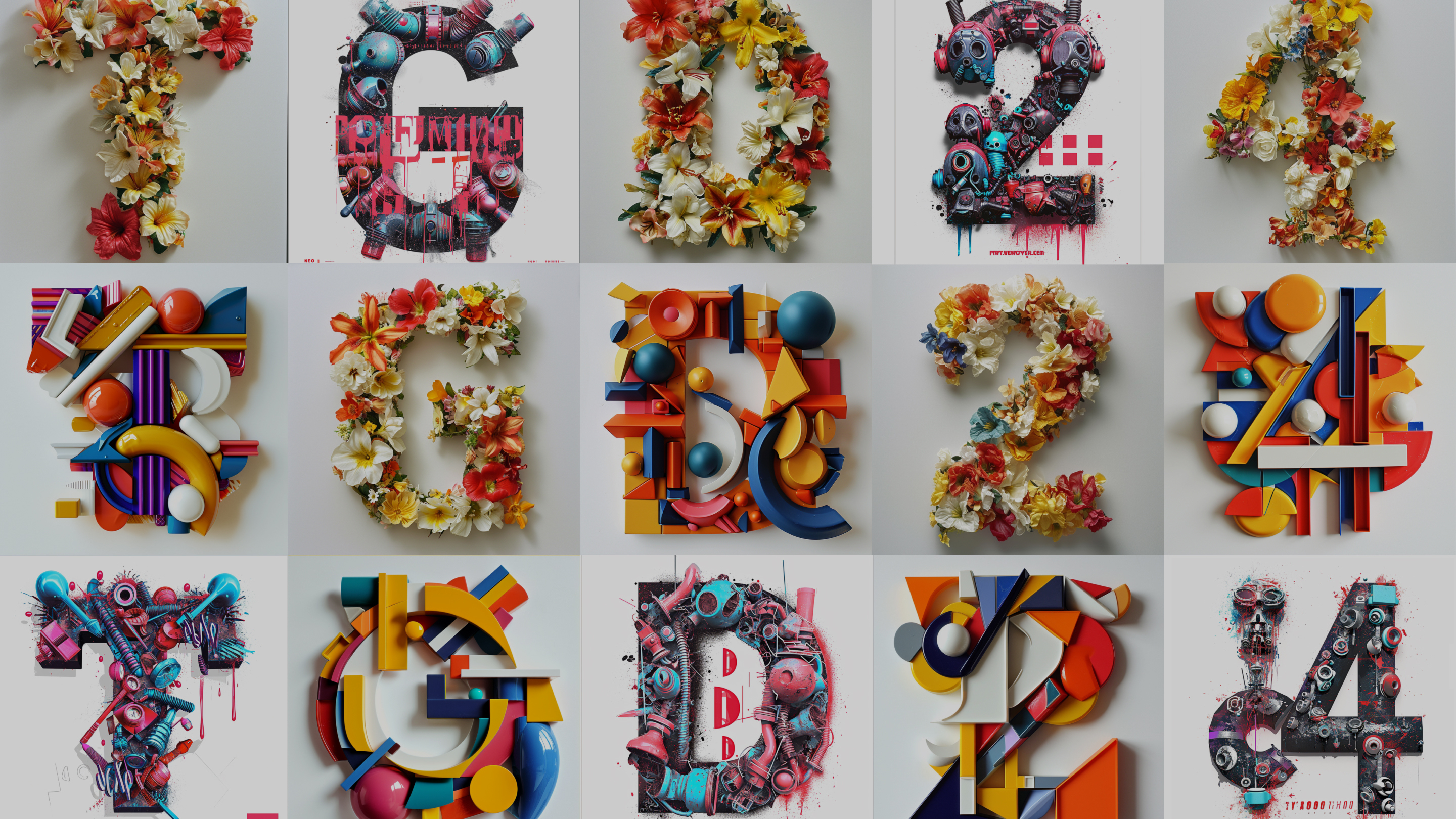
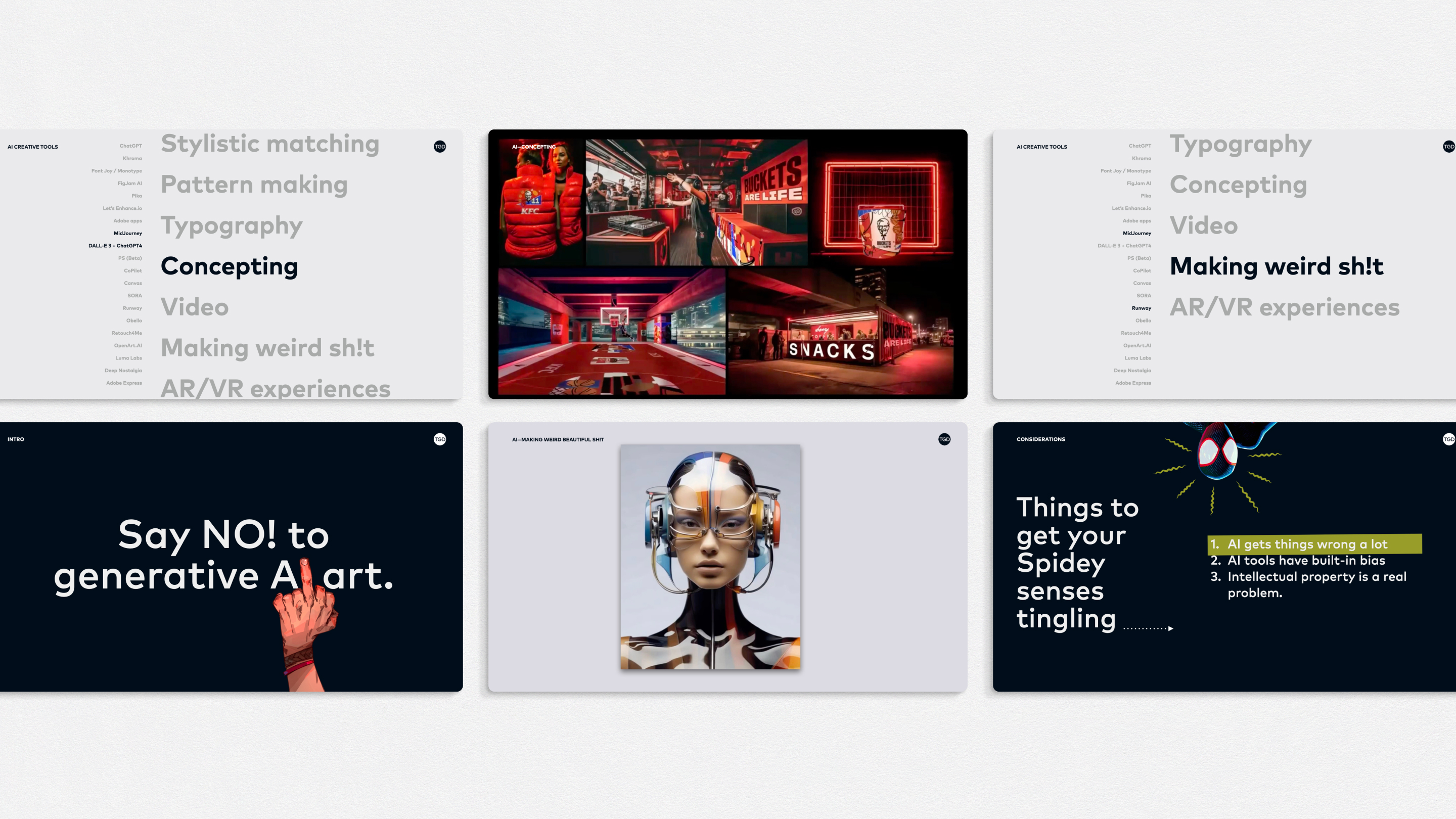
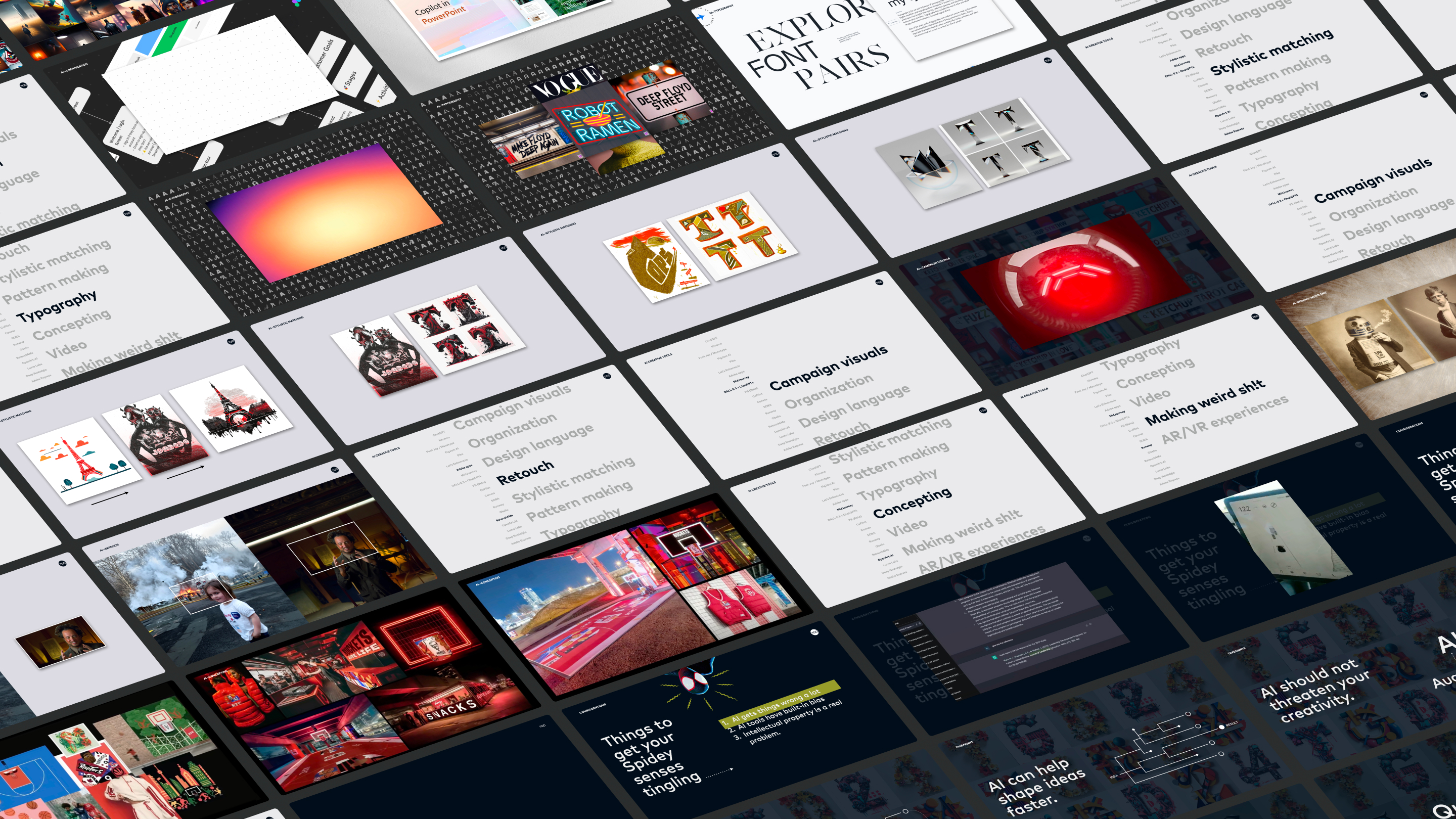
A while back, I gave a company-wide talk about AI and what it might do to unlock our creative potential: more output, faster ideation, fewer clicks. Nearly three years later, I’m still exploring what these tools make possible, with more attention to what we choose to produce. Here are three slides I’d slip in as key takeaways.
Full Flood
framed

Article Copy
XL
In early 2024, the conversation around AI swung between extraordinary possibility and the fear of being replaced. Creative tools were multiplying, and the demonstrations were jaw-dropping. In less than a year, we’d gone from the unnerving video of Will Smith shoveling spaghetti into his face to Sora’s minute-long video of a woman walking through neon-lit Tokyo. Sora had been announced earlier that week, and I showed the video in the talk. It was hard to believe how far the tools had come.
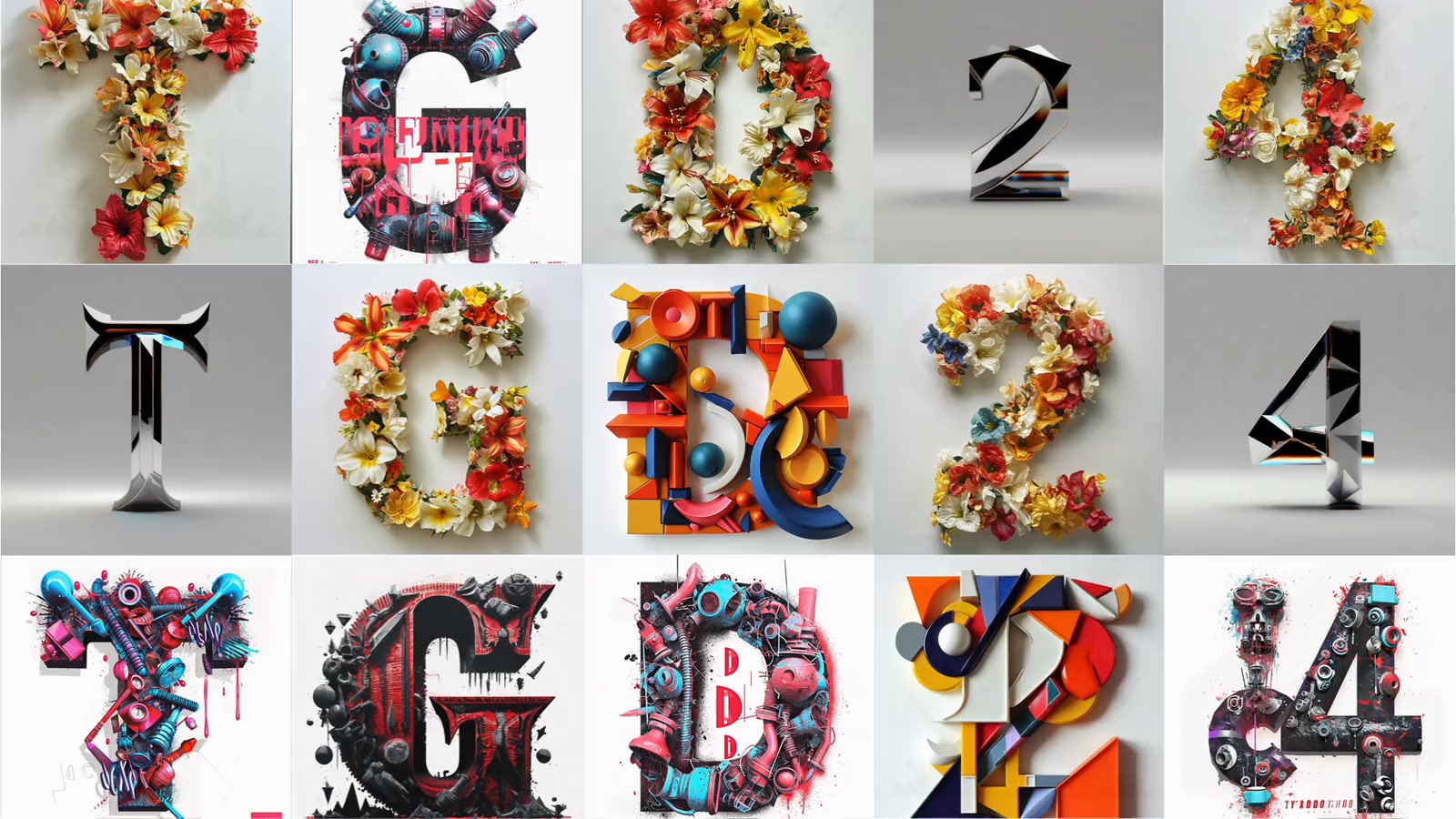
I knew there would be resistance in the room, so the talk addressed concerns about AI alongside its possibilities. We looked at experiments with typography, new approaches to developing concepts and AI-assisted retouching, as well as everyday applications such as organizing information and reducing repetitive production tasks.
We also covered accuracy, bias, authorship and copyright. We established boundaries around confidential client information and generated imagery in final work, while encouraging research and early exploration.
The takeaway was to approach AI as we would any creative tool: learn what it can do, understand its limitations and decide where it can help the work.
In the conversation afterward, I said we would all have to step up our game. These additions put some specifics behind that thought.
Full Flood
XL
Full Flood
Tight
Statement
Large
XL

Show the work in a way that supports the decision.
01
Show the work in a way that supports the decision.
01
Show the work in a way that supports the decision.
01
Article Copy
XL
Working with Epson, our team used a combination of AI and creative tools to manipulate images of Shaq for in-store display concepts. We were finding ways to move faster and make better comps.
The client and our own leadership questioned the level of finish. The images looked so refined that they felt we had spent too much time on fidelity for a first round. They wanted a napkin sketch. They didn’t realize this was our napkin sketch.
They were interpreting the images through their experience of how much work that finish normally required. Our process had changed. Their expectations hadn’t.
That puts a responsibility on us to bring people into the process. We need to explain what we’re showing, how preliminary it is and what we’re asking them to decide.
I’ve often tried to give the concepts I bring to a client equal weight and comparable detail. I want the discussion to be about which direction to take. If one route looks substantially more developed, we’ve introduced another reason to choose it.
AI makes a convincing visualization easier to produce. We still have to judge which details help someone understand the idea and which draw attention away from the decision. Sometimes a fuller picture helps. Sometimes we need to strip things away.
Statement
Large
XL

Use AI to challenge your thinking before helping you defend it.
02
Use AI to challenge your thinking before helping you defend it.
02
Use AI to challenge your thinking before helping you defend it.
02
Article Copy
XL
When I’m making a case for an idea, I’ve found it easy to create what I call the AI echo chamber. I give the tool a direction, it helps develop the argument and the response becomes increasingly convincing. But we may simply be getting better at defending the same assumptions.
So I’ve started asking it to poke holes in what I’ve done. I give it the objectives and relevant information, then ask where the argument falls short. Which claims haven’t I supported? Have I addressed the problem, or made a persuasive case for an idea I already wanted to pursue?
I want objections I can examine against those objectives and the source material. Asking for disagreement can produce a confident critique just as easily as asking for support can produce a confident endorsement.
I still have to decide whether the criticism holds up. Sometimes I need to change the argument. Sometimes I need to supply missing context or reject an objection that doesn’t fit the task.
That makes the exchange a useful sounding board. It helps me find weaknesses while I can still address them and better understand the choices I’m making.
Statement
Large
XL

Keep developing the expertise you bring to the tools.
03
Keep developing the expertise you bring to the tools.
03
Keep developing the expertise you bring to the tools.
03
Article Copy
XL
In the talk, I showed some awesome clothing concepts prompted by fashion designers. Part of what interested me was the knowledge a clothing designer could bring to that process.
Understanding construction, stitching and materials gives someone specific things to ask for, as well as reasons to question the result.
That expertise enters the process well before the final selection. It shapes the possibilities someone can describe and the details they recognize as worth developing.
The same applies to our own work. If I’m relying on a tool to supply a direction and explain why it works, I need enough understanding to examine both. I want to be able to intervene, develop the idea and recognize where it falls short.
Some of that understanding comes through making. Revising a concept can reveal whether the problem lies in the execution or the idea itself. Trying alternatives and responding to feedback gives us experience we can bring to the next decision.
That doesn’t mean preserving every repetitive task. It means being deliberate about where learning happens as the process changes.
As a creative leader, I need to leave room for people to try, revise, and explain their decisions. I also need to keep doing that work myself. Getting to a presentable answer sooner is absolutely useful, but we will still need to understand what makes it work and how to improve it.
A colleague once put it this way: “We should be the ones tempering the machine, never the other way around.” That requires knowledge we continue to develop and a willingness to use it.
Statement
XL
Strong
AI is giving creative teams more capability. I want that to make us more demanding of the work and more deliberate about our decisions.
AI is giving creative teams more capability. I want that to make us more demanding of the work and more deliberate about our decisions.
AI is giving creative teams more capability. I want that to make us more demanding of the work and more deliberate about our decisions.
hello@
Ryan
Burlinson
.com


© 2026 Ryan Burlinson. All rights reserved.